I1740–1800
Lemunahuel
“Puma of the forest.” Patriarch of the lineage. Lonko of peace on the Chol Chol river basin; root of a lineage that led with dialogue first.
Mapuche lawyer Expert in Indigenous Peoples, Human Rights and International Cooperation
Works on UNDRIP implementation, Free Prior and Informed Consent, and the UN mechanisms, so indigenous peoples' rights are honored in practice, not just on paper.
Councils, fellowships & affiliations
UN · OHCHR
Indigenous Fellow · Business & Human Rights Forum, Geneva
One Young World
Indigenous Advisory Circle
Codelco
Expert Advisory Council · Indigenous Peoples · 2025
Melton Foundation
Fellow · Global Solvers Accelerator · 2024
The Possibilists
Global Council
Changemaker x Change
Fellow · Global network of young leaders
Indigenous policy · International law
Analysis with a stance: UN mechanisms, UNDRIP implementation, and indigenous policy in Latin America. One peer-reviewed academic publication, with new essays in preparation.
International human rights standards applied to the situation of the Mapuche people after the Catrillanca case. Co-authored with Margarita Calfío Montalva and Verónica Figueroa Huencho. (In Spanish.)
Anuario de Derechos Humanos · U. of Chile · 2019
Read →Indigenous self-determination requires both legal recognition and economic autonomy: why indigenous peoples need their own institutions and enterprises, not only dependence on the state.
La Tercera · Opinion · 2021 · ES
Read →In preparation: a series of three essays on the implementation of UNDRIP, Free Prior and Informed Consent, and ancestral intelligence. 2026.
In the press
Areas of specialization
Each front applies the same international standard to a concrete problem: consultation, conflict, economy, and technology.
UNDRIP, ILO Convention 169, and the UN mechanisms as an applicable legal framework. FPIC as a collective right and as a process: international standards, comparative jurisprudence, and design of consent processes with intercultural legitimacy for States and companies.
Intercultural Bridges Methodology: know, reconcile, trust, build. From the language of confrontation to the transformation of conflicts between indigenous peoples, States, and companies. Certified socio-environmental and intercultural mediator.
Self-governance and economic development with identity. Social entrepreneurship models and the strengthening of indigenous enterprises that sustain community autonomy without assimilation.
The intersection of AI and the collective rights of indigenous peoples: data sovereignty, algorithmic bias, digital cultural heritage, and AI governance through the lens of UNDRIP. The Impacto Indígena AI project.
Koñwepang Lineage · 1740 → present
What he knows of his people he learned not first in books, but in nütram (conversation) with his grandfather Antonio, a lonko. Build indigenous institutions and forge alliances without assimilation: from Lemunahuel to today, the strategy of the küpalme has not changed, only the tools.
“Puma of the forest.” Patriarch of the lineage. Lonko of peace on the Chol Chol river basin; root of a lineage that led with dialogue first.
The most influential Mapuche politician in contemporary Chilean history. First indigenous minister in the history of Chile (Lands and Colonization, 1952). Three-term congressman. Founded the Corporación Araucana (1938). First speech in Mapudungun in Congress (1950).
Grandfather. Lonko and guardian of mapuche feyentun. Passed on the history of the küpalme and asked that his grandson carry the patriarch's name, Lemunahuel.
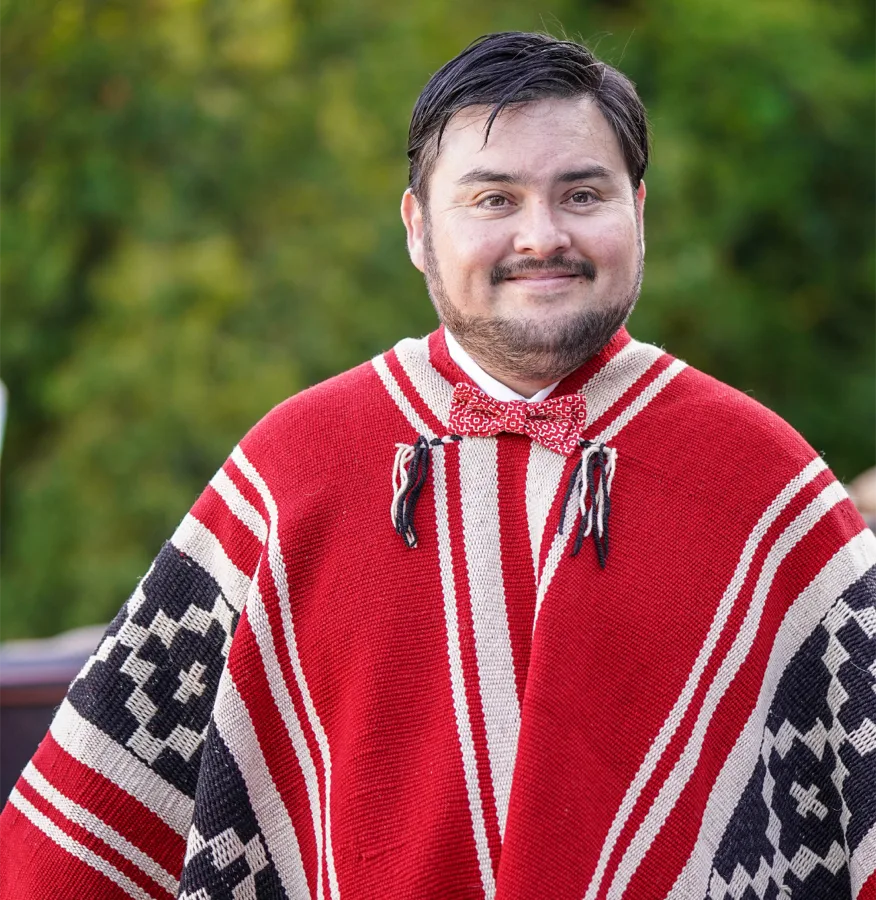
Carries the patriarch's name. He studied law for a simple reason: he grew up watching rights recognized on paper that were almost never honored in practice. He became a lawyer not to leave his community, but to translate in both directions, from the territory to the institutions and back. Like his forebears, he chose to build his own institutions. Today: UN, UNDRIP, AI.
The eighth generation, today
Mapuche lawyer. JD (Universidad Católica de Temuco), LLM in Regulatory Law (Pontificia Universidad Católica de Chile), and a Postgraduate Certificate in Indigenous Peoples, Human Rights and International Cooperation (Universidad Carlos III de Madrid, FILAC scholarship). Certified socio-environmental and intercultural mediator. Co-founder of Fundación KM.
Koñwepang · Millakir
conuepanmillaquir.cl
→ Artificial Intelligenceimpactoindigena.ai
→@fundacionkm
—We, indigenous peoples, are not an obstacle to development. We are its oldest source of legitimacy.
For government agencies, international cooperation bodies, academic institutions, and United Nations organizations, and for indigenous peoples' own organizations.